The 15-Minute Inspection: What to Check Before You Buy a Cheap Car
You're not buying new. You're buying someone else's used car for cash — and that's the whole point. But "cheap" should never mean "surprise." Fifteen focused minutes with this checklist will catch the problems that turn a bargain into a burden. Bring a friend, bring a flashlight, and take your time.
Before you go
- Ask for the VIN up front and run it through the free NHTSA VIN decoder — confirm the year, make, model, and trim match what the Giver listed.
- Check for open recalls at nhtsa.gov/recalls with the VIN. Recalls are fixed free by dealers — but you want to know they exist.
- Meet in daylight. You cannot inspect a car properly in a dark parking lot. If the Giver insists on nighttime, that's information too.
Walk-around: body and frame (3 minutes)
- Panel gaps and paint. Stand back and look down each side. Wavy reflections, mismatched paint shades, or uneven gaps between panels mean bodywork — ask what happened.
- Rust. Check wheel wells, rocker panels (under the doors), and the bottom edge of doors and trunk. Surface rust on an old car is normal; flaking, bubbling, or holes in structural areas are not.
- Tires. All four should match in size — matching brand is nice but not a deal killer, and mismatched brands are common on used cars. Check the tread wear indicators: modern tires have small raised bars running across the tread grooves. If a wear bar sits flush with the surrounding tread, those tires are done — replace ASAP. The old penny test works too: if you can see the top of Lincoln's head, they're due. Uneven wear (bald on one edge) means alignment or suspension issues.
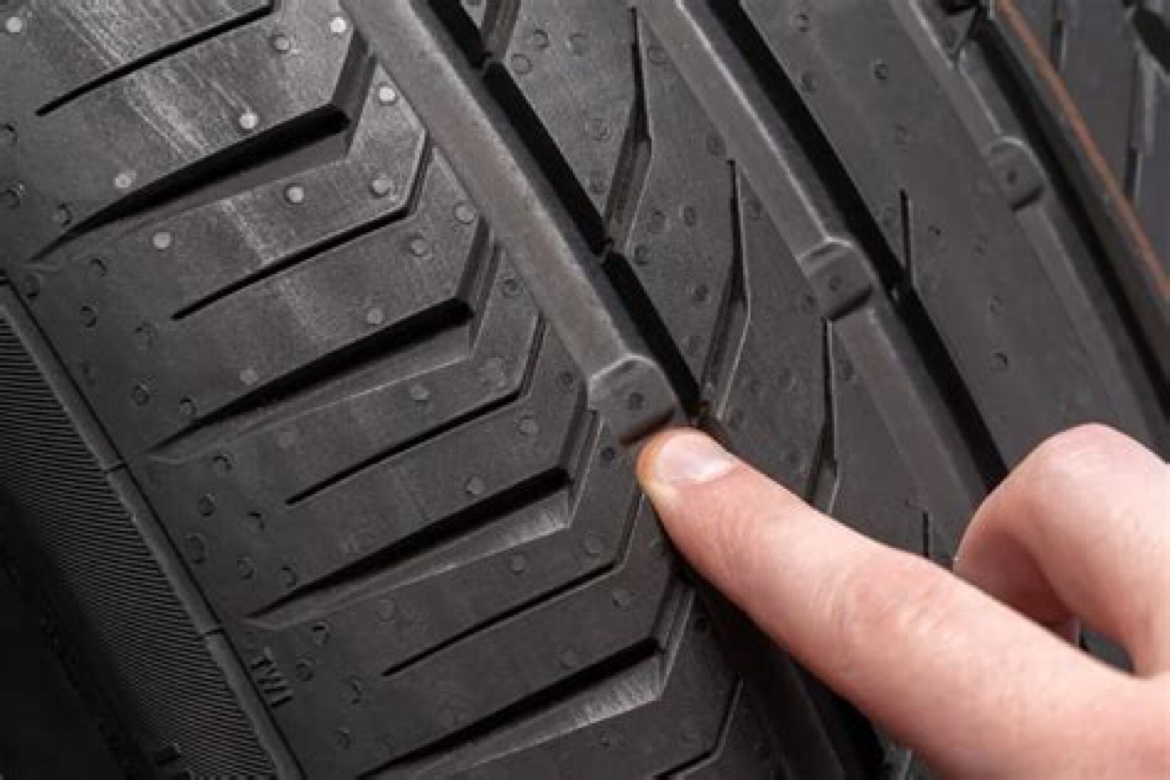 Tread wear indicator — the raised bar between the grooves. When it's flush with the tread, the tire is done.
 - Glass and lights. Cracked windshield? All headlights, taillights, and turn signals working? Cheap fixes individually, but they add up — and they're negotiating points.
Under the hood (4 minutes)
You don't need to be a mechanic. You're looking for neglect, not diagnosing.
- Oil. Pull the dipstick. Oil should be amber to dark brown and feel slick between your fingers. Milky or foamy oil means coolant is mixing in — walk away. No oil on the stick at all means walk away faster.
- Coolant. Look at the overflow reservoir (never open a hot radiator cap). Coolant should be green, orange, or pink — not brown, not rusty, not oily.
- Belts and hoses. Squeeze the big radiator hoses — they should be firm, not mushy or cracked. Belts shouldn't be frayed or glazed shiny.
- Battery. Corrosion (white/green crust) on the terminals is a cheap fix, but check the battery's date sticker — over 4–5 years old means it's living on borrowed time.
- Leaks underneath. Look at the ground where the car was parked, then peek under the front. On a hot or humid day the A/C can leave even a proper puddle — that's fine as long as it's clear water. Touch it if you're unsure: oil feels slick, coolant feels slightly slimy and is usually green, orange, or pink. Oil, red transmission fluid, or coolant puddles are not fine.
Inside: the stuff you'll live with (3 minutes)
- Start it cold. Ideally the engine is cold when you arrive — a warm engine can hide starting problems. It should crank promptly and settle into a smooth idle. Blue smoke from the exhaust means burning oil; white sweet-smelling smoke means coolant trouble.
- Every button and switch. Windows, locks, mirrors, wipers, washer fluid, horn, hazard lights, heat, A/C (must blow cold), radio. Test them all — each dead one is money or annoyance.
- Dashboard lights. Turn the key to "on" without starting: every warning light should illuminate, then go out after starting. A light that never comes on may have had its bulb removed to hide a problem. A check-engine light that stays on needs a code read — most auto parts stores do it free.
- Seats, belts, and smell. Seatbelts should retract and latch. A musty smell means water intrusion — pull up the trunk carpet and check the spare tire well for standing water or rust.
The test drive (5 minutes)
- Brakes. At low speed in an empty area, brake firmly. The car should stop straight without pulling, grinding, or a pulsing pedal.
- Steering. On a straight road, briefly loosen your grip — the car should track straight. Vibration at speed often means tire or alignment issues.
- Transmission. An automatic should shift smoothly with no slipping, clunking, or hesitation. A manual's clutch should engage without chatter or slipping uphill.
- Listen. Turn the radio off. Knocking, grinding, whining, or clicking on turns are all telling you something — note them and ask.
- Heat and A/C under load. Run the A/C on the drive. If the temperature gauge climbs, the cooling system has a problem.
Red flags — walk away, no matter the price
- Title not in the Giver's name, or no title at all
- VIN on the car doesn't match the VIN on the title
- Milky oil or heavy white exhaust smoke
- Frame damage or heavy structural rust
- The Giver won't let you take it for an independent inspection
- The deal feels rushed — "someone else is coming in an hour"
A cheap car with honest flaws is a good car. A cheap car with hidden ones is an expensive one. This checklist is how you tell the difference — in fifteen minutes, with a flashlight and your own two eyes.
Found something on this list during an inspection and not sure what it means? Bring it to the Paid For Car community — plenty of car people there happy to talk it through.